

Big Tech Is All In on AI - But Customers Aren't. Wall Street Is Starting to Notice.
A fresh tech selloff has reignited fears of an AI bubble, as investors question whether the $7.6 trillion being poured into AI infrastructure will generate sufficient consumer and business demand to justify the costs. With few users willing to pay for AI, Gartner finding poor enterprise ROI, and Pew Research showing 40% of Americans expect AI to be a negative societal force, analysts warn the AI ecosystem's math only works if revenue growth holds through 2030 — a big assumption.

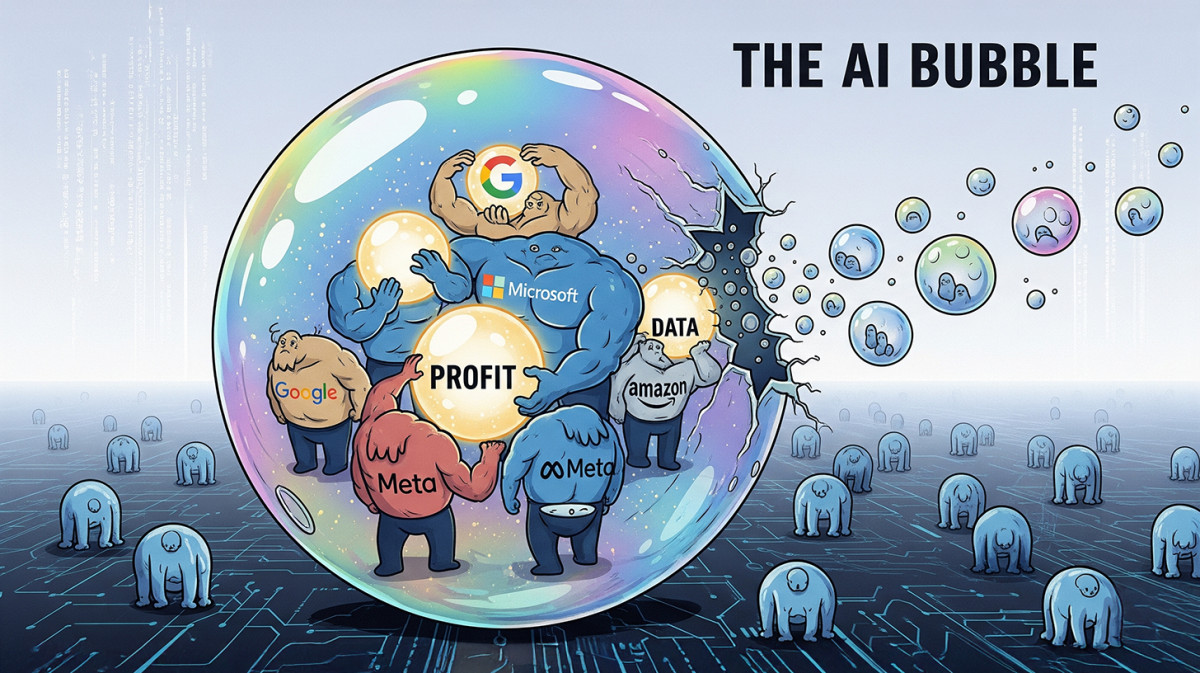
Technology companies are betting trillions of dollars that consumers and businesses will open their wallets for artificial intelligence. Wall Street is increasingly asking what happens if they don't.
The Nasdaq Composite slipped nearly 3% this week as investors fretted over whether the staggering capital being deployed into AI will generate the revenue and profit growth needed to justify it. Goldman Sachs estimates tech companies will spend $7.6 trillion through 2031 building the data centres required to power AI — much of it financed through debt markets.
The returns, so far, are not keeping pace. "There's concern around how much hyperscalers are turning to debt markets to finance the infrastructure buildout," Kate Brennan of independent research institute AI Now told CBS News. "The returns are not coming in, and the claims being made in terms of efficiency or productivity numbers are not netting out."
Few Consumers Are Paying
Americans are increasingly using AI — but few are paying for it. A Bank of America study found limited consumer willingness to spend on AI services, while a June 2026 Pew Research survey found 40% of adults believe AI will be a negative societal force over the next two decades, versus only 16% who view it positively.
On the enterprise side, the picture is similarly mixed. A May 2026 Gartner study found that businesses replacing workers with AI agents frequently fail to generate a return on investment — suggesting that the corporate AI wave has yet to translate into measurable productivity gains at scale.
Brennan argued that much of the current AI adoption is less about genuine demand and more about the technology being unavoidable — embedded into Google search results, company helplines, and consumer-facing apps by companies with financial incentives to push it everywhere, whether demand exists or not.
Bubble or Boom?
The anxiety has drawn inevitable comparisons to the dotcom boom of the late 1990s. Like that era, the AI buildout will likely produce uneven outcomes — some firms emerging stronger, others rendered obsolete. Vanguard's global head of capital market research Qian Wang and senior economist Kevin Khang noted this week that the market's sensitivity to AI's ups and downs will remain significant as investors continue to learn what the economics of AI look like in practice.
Economist Ed Yardeni of Yardeni Research put it plainly: "The AI ecosystem falls apart if expected end-user demand for AI products does not materialise, or if prices fall sharply below expectations." His team's analysis of OpenAI and Anthropic's annualised revenue estimates against their spending commitments — what he calls a "capex payback test" — found the ecosystem is not yet fully revenue-backed, but not entirely speculative either. The math improves significantly by 2030, but only if AI revenues continue to scale and compute efficiency improves — a large assumption to carry for six more years of trillion-dollar spending.
What's Your Reaction?
 Like
0
Like
0
 Dislike
0
Dislike
0
 Love
0
Love
0
 Funny
0
Funny
0
 Wow
0
Wow
0
 Sad
0
Sad
0
 Angry
0
Angry
0















Comments (0)