

SpaceX Goes All-In on Nvidia, Announces Plans to Launch AI Data Centres Into Orbit in 2027 - Up to 1 Million Satellites
SpaceX and Nvidia have announced a joint partnership to develop the compute payload for the Starmind AI1 satellite - a spacecraft designed to run large-scale AI workloads from low Earth orbit using Nvidia's Rubin GPUs and Vera CPUs. Each satellite will pack 150 kW of peak compute power into a 20-metre-tall, 70-metre-wingspan spacecraft. Prototype testing is targeted for early 2027, with mass production by late 2027. SpaceX CEO Elon Musk confirmed SpaceX will build data centres exclusively with Nvidia, disclosing the partnership during the company's first earnings report since going public in June.

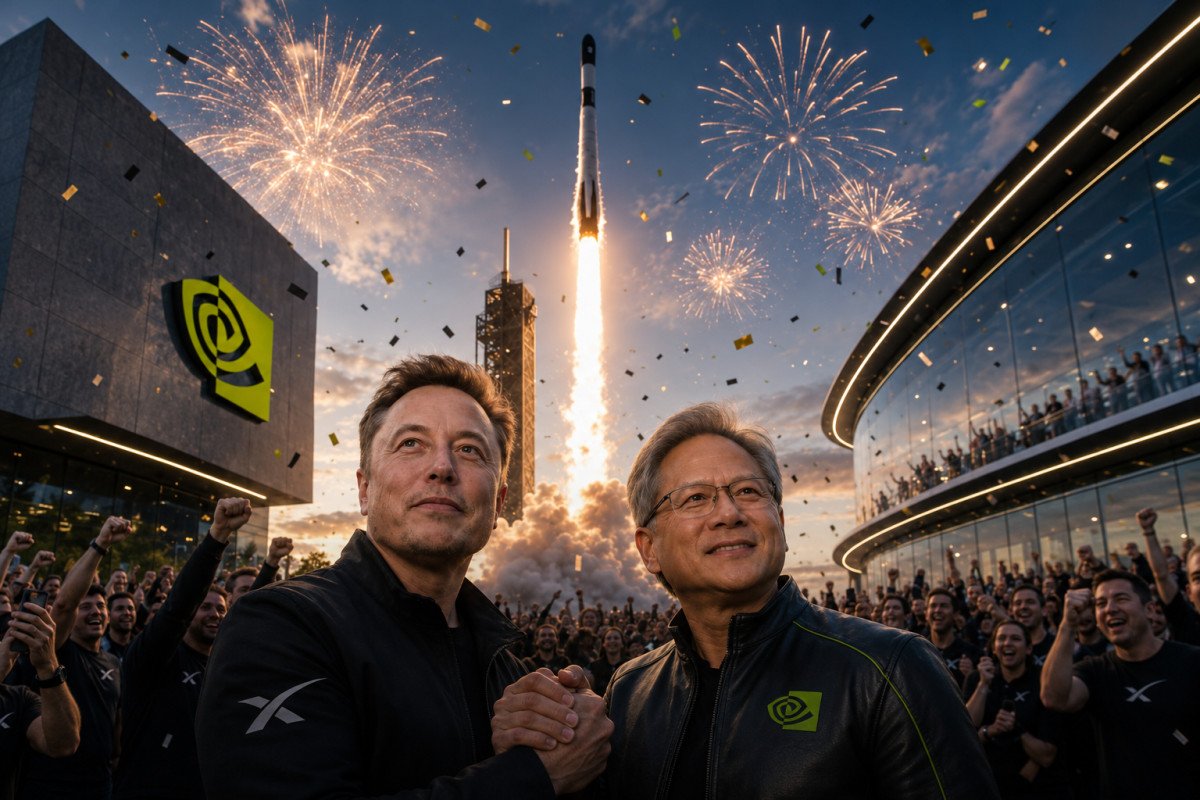
The data centre is leaving Earth. SpaceX and Nvidia jointly announced on August 4 that they are developing the compute payload for the Starmind AI1 satellite - a spacecraft designed to run serious artificial intelligence workloads from low Earth orbit using Nvidia's most advanced silicon. The two companies are targeting a megaconstellation of up to 1 million satellites, each one functioning as a node in what would effectively become the world's first distributed AI supercomputer in space.
Elon Musk confirmed that SpaceX will build data centres exclusively using Nvidia's graphics chips, making the remarks during SpaceX's first earnings report since going public in June. The company topped analyst expectations on both revenue and earnings, with AI revenues climbing 213% quarter over quarter and 247% year-on-year to $2.6 billion, driven by cloud service agreements and increased Grok and X subscriptions.
The AI1 Satellite: A Data Centre With Wings
The AI1 satellite stands 20 metres tall with a solar wingspan of 70 metres - roughly two-thirds the length of a Boeing 747 - to harvest enough sunlight to feed its power appetite. Each satellite is engineered to sustain roughly 120 kW of average compute power, with peaks reaching 150 kW.
Hovering 600 to 800 kilometres above Earth, the AI satellites will support latency of approximately 3 milliseconds. Musk described the initial satellite's compute capacity plainly: "Think of it as a rack of compute in space." The current reference design supports both the Nvidia GB300 and its new Vera Rubin platform engineered for agentic AI.
SpaceX controls the launch vehicle, the satellite bus, the chip, the solar supply chain, and the manufacturing facility - a level of vertical integration no competitor currently matches.
The Nvidia Silicon Powering It
Nvidia revealed its Vera Rubin Space Module at GTC 2026 in March, designed for orbital data centres, geospatial intelligence, and autonomous space operations - offering up to 25x more AI compute power for space-based inferencing compared to the H100.
Jensen Huang said: "AI processing across space and ground systems enables real-time sensing, decision-making and autonomy, transforming orbital data centers into instruments of discovery and spacecraft into self-navigating systems. We're extending NVIDIA beyond our planet."
Timeline and Regulatory Status
Initial prototype testing is targeted for early 2027, with mass production expected to begin by late 2027. The FCC granted an initial application earlier this year but has not issued a final decision on broader satellite deployment. SpaceX's Bastrop manufacturing facility is targeted to reach significant production levels by end of 2027.
The Physics Case for Orbital AI
The rationale for orbital data centres is grounded in physics. Without the filtering effects of Earth's atmosphere, solar panels in orbit can harness sunlight at full intensity - companies estimate this could cut energy costs by up to ten times compared to terrestrial facilities, even accounting for launch costs. Space also eliminates land acquisition costs, permitting bottlenecks, and much of the cooling infrastructure that defines terrestrial data centre capex. Radiators vent heat directly into the vacuum of space, eliminating the need for conventional cooling systems.
The Race Is On
SpaceX and Nvidia are not alone. Google is in talks with SpaceX and other launch providers for its "Suncatcher" orbital data centre project. Blue Origin is pursuing the same concept, as are Nvidia-backed Starcloud and orbital AI inferencing startup Orbital. Aetherflux is targeting a first data centre satellite launch in Q1 2027.
Nvidia shares gained about 3% on news of the Starmind partnership, while SpaceX stock climbed nearly 9%. The market's verdict was immediate: orbital AI compute is no longer a thought experiment. It is a race - and SpaceX, with Nvidia's silicon and its own rockets, just put itself at the front of it.
What's Your Reaction?
 Like
0
Like
0
 Dislike
0
Dislike
0
 Love
0
Love
0
 Funny
0
Funny
0
 Wow
0
Wow
0
 Sad
0
Sad
0
 Angry
0
Angry
0













Comments (0)