

No Turbines. No Compressors. No Moving Parts. This Indian Startup Just Fired the Engine That Could Change Supersonic Flight Forever.
Delhi-based D-Propulse Aerospace, founded in July 2025 and incubated at IIT Madras, has successfully tested a 5-kilonewton air-breathing Rotating Detonation Engine at a DRDO facility in Hyderabad - achieving Technology Readiness Level 5 and becoming one of the very few teams globally to demonstrate an RDE beyond lab scale. The startup, co-founded by defence analyst Saurav Jha and ex-DRDO scramjet scientist Dr V. Ramanujachari, is building India's first RDE-powered propulsion system for hypersonic drones and missiles - with no moving parts, 25% better thermal efficiency, and a cost structure that could democratise precision high-speed flight.

Every jet engine ever built has one thing in common: it moves. Turbines spin, compressors whir, fans rotate. That mechanical complexity is the price aviation has always paid for thrust. A year-old Indian startup called D-Propulse Aerospace just demonstrated, at a government test facility in Hyderabad, that it does not have to be.
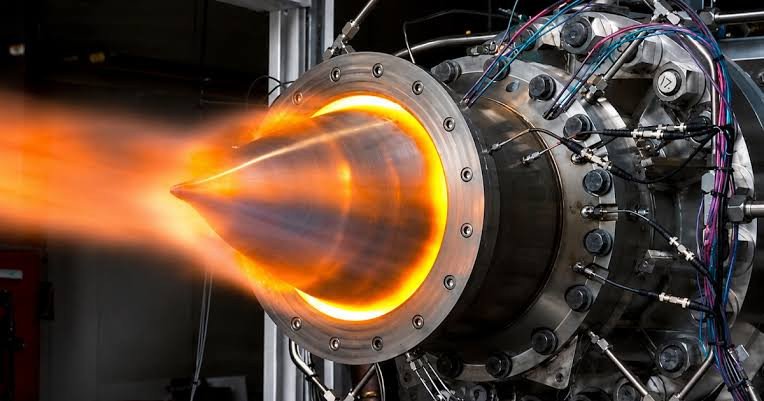
On July 22, 2026, D-Propulse successfully fired a 5-kilonewton air-breathing Rotating Detonation Engine integrated with an aerospike nozzle at the Defence Research and Development Laboratory in Hyderabad - achieving Technology Readiness Level 5. Few nations have demonstrated RDEs beyond lab scale. TRL-5 positions India among the earliest movers in this disruptive technology. A short video posted by co-founder and CEO Saurav Jha on X showed a stainless steel cylinder producing a sharp, defined plume of fire - understated footage for what is, by any measure, a milestone moment in Indian aerospace.
The Engine That Detonates, Not Burns
To understand why this matters, it helps to understand what conventional engines actually do. Standard jet engines rely on deflagration - controlled, subsonic burning of fuel that releases energy gradually. It works, but it is thermodynamically inefficient, mechanically complex, and expensive to build and maintain.
A Rotating Detonation Engine works on an entirely different principle. Rather than burning fuel in a controlled flame front, RDEs harness supersonic detonation waves - creating a continuous rotating detonation that wraps around the inside of a cylindrical combustion chamber. The result is a fundamentally more energetic release of pressure, more thrust from the same fuel, and - critically - no moving parts, making RDEs mechanically simpler, easier to manufacture, and more reliable at scale than even traditional ramjets and scramjets.
D-Propulse claims its RDE delivers thermal efficiency gains of more than 25% over conventional engines - meaning a smaller, lighter engine producing equivalent thrust at lower cost. The company describes itself as building India's first rotating detonation engine, and the DRDO test confirms it is no longer merely building on paper.
Born From a War, Built for What Comes Next
The origin story of D-Propulse lies in Operation Sindoor, when co-founder Saurav Jha - a former defence analyst and founder of the Delhi Defence Review think tank - noticed how decisive India's supersonic strike capabilities were during the brief conflict with Pakistan. The realisation was straightforward: the next generation of air defence would increasingly neutralise slower, radar-visible platforms. What India needed was the ability to deploy fast, precise systems at scale - and the propulsion technology to make that possible.
D-Propulse was launched in July 2025 as an IIT Madras-incubated startup. Jha's co-founder, Dr V. Ramanujachari, is a retired DRDO scientist who led India's scramjet engine programme and worked on propulsion for the Akash missile. In June 2026, former DRDO Chairman and NITI Aayog member Dr V.K. Saraswat joined as Chairman of the Board, while Professor S. Chakravarthy, who heads the National Centre for Combustion R&D at IIT Madras, serves as chief advisor. It is a team that blends policy intelligence, deep field experience, and frontier research in a way few Indian defence startups have managed.
What It Is Building and For Whom
D-Propulse says it is working towards flight-capable demonstrators, with the aim of building bespoke platforms such as high-supersonic drones as well as the engines themselves. The 5 kN RDE tested at DRDO Hyderabad is described as the proof motor for a flight-capable design - the step between validated technology and actual deployment.
By offering performance comparable to today's high-speed weapons at a fraction of the cost, the company seeks to enable "mass in precision" - the ability to deploy fast, accurate systems at scale. In a defence landscape where a single hypersonic missile costs tens of millions of dollars, a cheaper RDE-powered alternative could fundamentally change how India - and its adversaries - think about saturation strikes, drone swarms, and precision munitions.
Funded and Moving Fast
D-Propulse raised Rs 25 crore from IAN Alpha Fund in a round announced in January 2026, with IIT Madras and the Indian Angel Network also listed among its backers. The money is going towards developing propulsion for high-supersonic and hypersonic platforms.
For a company founded in July 2025, the pace of progress is striking - from incorporation to a DRDO-validated 5 kN RDE test in just over a year. Most deep-tech defence startups take three to five years to reach equivalent milestones. D-Propulse's RDE combines efficiency, adaptability, and validated readiness in a way that positions India among the early movers in supersonic propulsion globally.
The engine has no moving parts. But the startup itself is moving very fast indeed.
What's Your Reaction?
 Like
0
Like
0
 Dislike
0
Dislike
0
 Love
0
Love
0
 Funny
0
Funny
0
 Wow
0
Wow
0
 Sad
0
Sad
0
 Angry
0
Angry
0















Comments (0)