

The Pause That Gives AI Away Is Now Gone - Smallest.ai Raises $13 Million to Build Voice AI That Thinks While It Listens
San Francisco and India-based voice AI startup Smallest.ai has raised $13 million in a Series A round led by Seligman Ventures, with participation from Sierra Ventures and 3one4 Capital, taking total funding past $21 million. The IIT Guwahati-founded company has launched Voice 4.0 and its Hydra architecture - a speech-to-speech system that listens, reasons, and responds in parallel rather than sequentially - targeting financial services, healthcare, and contact centres with sub-second latency voice AI that aims to be indistinguishable from a human caller.

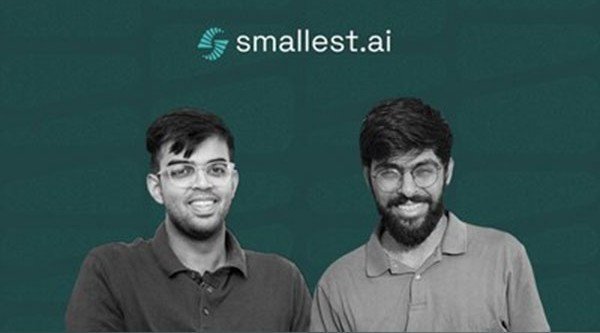
There is a tell that gives every AI voice agent away. It is not the accent or the vocabulary. It is the pause - that fraction of a second of silence after you finish speaking, while the system processes what you said before it can respond. Humans do not work that way. We listen and think at the same time. We interrupt. We overlap. We respond before the other person is fully done.
Smallest.ai was founded on the conviction that voice AI will only feel genuinely human when it is architected to work the same way. On July 31, the startup closed a $13 million Series A round to prove that conviction right.
The Round
The Series A was led by Seligman Ventures with participation from Sierra Ventures and 3one4 Capital. Additional backers included Better Capital, Upsparks Capital, Schema Ventures, Tiny VC, DeVC, and Mission Street Capital, bringing the company's total funding to more than $21 million. The round closed on July 30 - nine months after the company raised an $8 million seed round led by Sierra Ventures in October 2025.
The Architecture That Makes It Work
The centrepiece of the announcement is Hydra - Smallest.ai's new asynchronous speech-to-speech architecture. Unlike traditional voice systems that process tasks sequentially, Hydra handles listening, reasoning, and speech generation in parallel.
"The industry has focused on making models larger when the real challenge is architectural," said Sudarshan Kamath, CEO. "Humans don't wait for someone to finish speaking before they begin thinking. We listen, think and respond simultaneously. Voice AI needs to work the same way. That's why we built Smallest.ai around a real-time architecture that processes speech as it arrives, enabling faster, more natural conversations without sacrificing intelligence."
The result, the company claims, is sub-second latency - close enough to human response times that the uncanny valley of robotic voice AI effectively disappears. The Lightning model, first released at seed stage and described as the fastest text-to-speech model on the market, can generate 10 seconds of speech in 100 milliseconds.
The Full Platform
Alongside Hydra, Smallest.ai launched Voice 4.0 - a unified platform combining proprietary speech recognition, speech generation, and real-time conversational AI infrastructure. Smallest.ai's Pulse STT Pro speech-to-text model supports 38 languages, with capabilities including speaker diarization, emotion detection, and automated PII and PCI redaction.
The platform has been deployed by customers including RingCentral, Truecaller, Kogtal Financial, and Readymode, helping reduce customer support costs by as much as 80% in some cases, with up to 10x higher agent productivity.
The Market and the Competition
The global Voice AI market is projected to surge from $2.4 billion in 2024 to $47.5 billion by 2034 - and currently less than 1% of global voice interactions are AI-powered. That gap represents both the scale of the opportunity and the scale of the work left to do.
The competitive landscape is intensifying fast. Earlier this week, rival Fish Audio raised $52 million to expand its open-source voice model platform. Microsoft is embedding advanced voice capabilities into Teams and Azure. ElevenLabs, the most well-funded dedicated voice AI company, is expanding aggressively across enterprise use cases.
Smallest.ai is targeting financial services, healthcare, contact centres, and business process outsourcing - sectors where the cost of getting voice AI wrong is high, and where the value of getting it right at scale is enormous.
The Founders
Smallest.ai was founded in 2023 by IIT Guwahati alumni Sudarshan Kamath and Akshat Mandloi. The company is headquartered in San Francisco with a significant research presence in India - a structure that mirrors other globally ambitious Indian deep-tech startups that have chosen to build for enterprise at a global level from day one, rather than localising first and expanding later.
The company currently employs nearly 60 people and plans to significantly expand its workforce over the coming year as it uses the Series A to deepen its platform, scale commercial operations, and push into new geographies.
The pause is gone. Now the race is on.
What's Your Reaction?
 Like
0
Like
0
 Dislike
0
Dislike
0
 Love
0
Love
0
 Funny
0
Funny
0
 Wow
0
Wow
0
 Sad
0
Sad
0
 Angry
0
Angry
0










Comments (0)